

Architect Zebulun Lund
Appointed to the Board
 Governor Jim Pillen has appointed Zebulun (Zeb) J. Lund, AIA, NCARB, of Lincoln, to the Nebraska Board of Engineers and Architects. Lund is the Board’s architecture education member and has more than five years of experience as a licensed architect.
Lund earned both his Bachelor of Science in Design in 2015 and his Master of Architecture in 2017 from the University of Nebraska–Lincoln.
Outside his service to the Board, Lund is involved with the National Council of Architectural Registration Boards (NCARB) and the American Institute of Architects (AIA). His involvement includes serving on NCARB item-writing committees and as a peer reviewer for the AIA Conference on Architecture.
As a member of the Board, Lund looks forward to safeguarding the public welfare of Nebraska through the lens of architecture and bringing his experience in architectural education and professional practice to the Board’s mission.
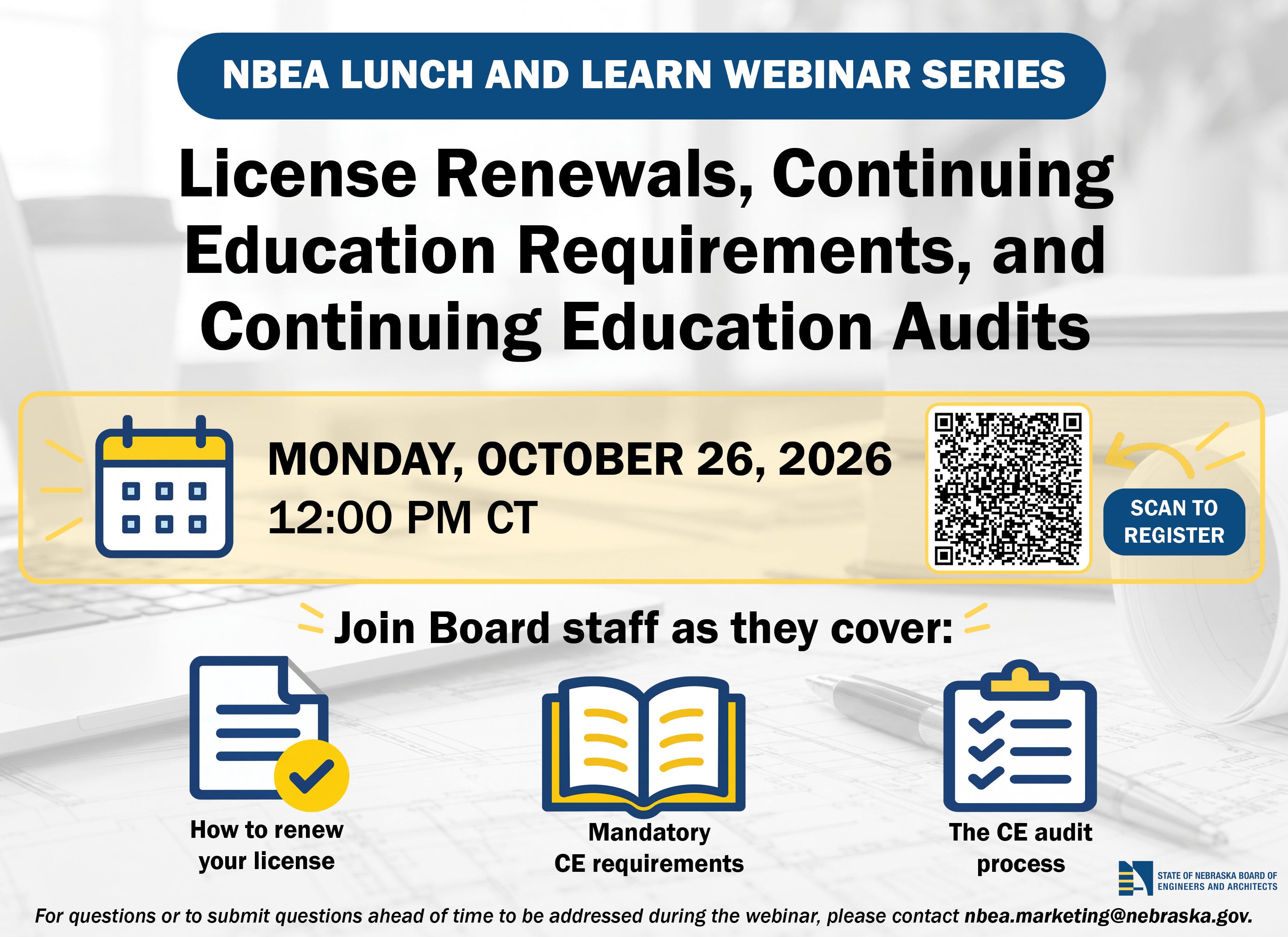
Upcoming NBEA Lunch and Learn Webinar: License Renewals,
CE Requirements, and CE Audits
Join the Nebraska Board of Engineers and Architects for a free webinar held through Microsoft Teams on Monday, October 26, 2026, at 12:00 PM CT covering the license renewal process, continuing education (CE) requirements, and the CE audit process.
With license renewal season upon licensees whose last names begin with L through Z, this Lunch and Learn is an opportunity to refresh your understanding of:
- License renewals and how to complete the renewal process;
- CE requirements, including what is required to fully and accurately complete your CE hours by the end of your audit cycle; and
- The CE audit process, including what to expect and what to do if you are selected for an audit.
Registration is required. Click here to register for the free webinar. You may also call in at +1 402-257-5560; Phone Conference ID: 910 476 853#.
Please share this invitation with others in your area who may benefit.
If you would like to submit questions in advance, please send them to nbea.marketing@nebraska.gov.
If you have any questions, please contact our office at nbea.marketing@nebraska.gov or (402) 471-3044.
Latest Lunch and Learn Webinar
Now Available Online
Thank you to everyone who attended the recent Lunch and Learn Webinar on supporting safe communities and when to engage Nebraska-licensed architects and/or professional engineers on a building project.
The recording is now available on the Board’s YouTube channel. View the PDF of the webinar here.
As a reminder, certificates will not be issued as attendance verification. If you participated in the entire presentation, you should have received an email confirming your attendance. Use that email as attendance verification if needed to substantiate CE hours for the webinar. You may need to check your email Junk or Spam folder for the confirmation email.
It is anticipated that the Board will give continuing education credit for the webinar, but as a reminder, the Board DOES NOT pre-approve continuing education offerings.
Follow the Board’s Facebook page for upcoming NBEA Lunch and Learn Webinar presentations and other important updates and information.
You can also visit our website for information on upcoming webinars, as well as YouTube videos and presentation documents from past webinars.
If you have any suggested topics for future webinars, please email nbea.marketing@nebraska.gov.
FAQs from Our Latest Webinar
Can local jurisdictions require a Nebraska-licensed architect and/or professional engineer on a building project even if the Act does not require it?
Answer: Yes. Local jurisdictions can be stricter but not less restrictive than the Act.
Per Board Rule 10.6, notwithstanding the exemptions, the responsible building official may require plans and specifications to be designed and prepared by an architect and/or professional engineer if the official finds a hazard to life, health, safety, or welfare due to the unusual circumstances of the building or structure or an unusually large number of potential occupants in relation to square footage for a particular occupancy.
Can draft documents be marked “Not for Construction” or “Preliminary” rather than “Draft”?
Answer: No. The documents will need to be clearly marked as “Draft.” The use of alternate phrases do not satisfy Board Rule 6.1.7, which states that documents clearly marked as “Draft” prepared for preliminary submission and review do not require the professional’s seal, signature, and date, including documents prepared for a client or governmental agency, unless otherwise required by that entity.
Is the square footage of a building based on the footprint or the actual square feet that can be utilized by the occupant?
Answer: Per Board Rule 10.2.4, building area shall be defined in the state building code established by Neb. Rev. Stat. 71-6403. Please refer to the statute.
If a building project is open-sided, is it exempt from the Act?
Answer: If the building project is subject to the Act based on its size and occupancy classification and involves the practices of architecture or engineering, the appropriate professionals need to be involved. The fact that a project is open-sided in and of itself doesn't necessarily exclude it from the “is it the practice or not” determination.
When placing a date on a seal, which date do we use?
Answer: The date will be the date on which the seal was placed on the technical document.
Can an interior designer be a Coordinating Professional?
Answer: No. Per Board Rule 6.3.1, a Coordinating Professional must be a licensed professional engineer, professional landscape architect, or architect recognized as such by the project owner.
Monthly Q&A with Board Staff:
Latest Session and Join Us Next Time
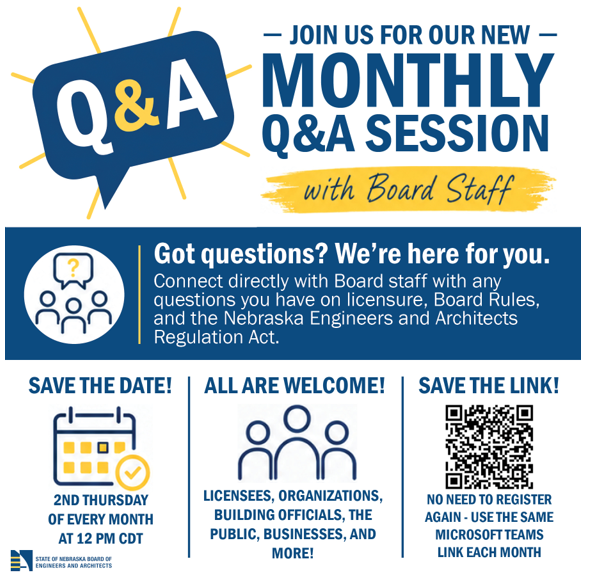 Thank you to everyone who attended the latest Monthly Q&A with Board Staff on Thursday, September 10, 2026! The conversation focused on license renewals and continuing education requirements.
The recording is now available on the Board’s YouTube channel.
Join Us for the Next Q&A
The next Monthly Q&A with Board Staff will be held on Thursday, October 8, 2026, at 12:00 PM CT. During this time, Board staff will review several frequently asked questions received during the Board’s recent Lunch and Learn presentation.
The Monthly Q&A is an informal webinar held through Microsoft Teams that provides an opportunity to ask questions and learn more about topics within the Board’s jurisdiction, including navigating licensure, professional practice, and building projects. No question is too basic. Each month’s discussion will vary based on the questions and topics submitted by participants.
Join us on the second Thursday of each month at 12:00 PM CT.
No registration is required. Simply use this recurring link to join.
You may also dial in by phone. Please call +1 402-257-5560 and enter the phone conference ID: 796 558 53#.
Important Reminders:
-
Board staff are not speaking on behalf of Board members.
-
These webinars are for general informational purposes only and do not constitute legal advice.
-
Please keep questions general and avoid sharing project-specific, personal, or identifying information.
-
It is anticipated that the Board will not give CE credit for these webinars. As a result, Board staff WILL NOT provide attendance verification for continuing education credits.
NCEES News
Beyond the Exam: NCEES Services for Engineers
NCEES offers more than exams for engineers. Many of their services are designed to help professional engineers become licensed in multiple states, track continuing professional competency requirements, and assist international professionals in becoming licensed in the United States.
-
Records Program: Designed for licensed engineers who are looking for an easier and quicker way to complete the licensure process in multiple jurisdictions, including all 50 states, as well as U.S. territories and other countries.
-
Credentials Evaluations: A service for state licensing boards and applicants, designed primarily for candidates who have earned their degrees outside the United States and are pursuing licensure through one of the member licensing boards of NCEES.
-
CPC Tracking: Most state licensing boards require licensed engineers to meet a continuing professional competency (CPC) requirement to renew their license. You can conveniently track and report your CPC requirements for free through your MyNCEES account.
Select a service above to learn more about how NCEES can support your licensure needs.
Preparing for the Fundamentals of Engineering Exam
Are you considering becoming a professional engineer (PE)? The Fundamentals of Engineering (FE) Exam is generally your first step in the licensure process.
The FE Exam is designed for recent graduates and students who are close to finishing an undergraduate engineering degree from an EAC/ABET-accredited program. The FE exam is a computer-based exam administered year-round at NCEES-approved Pearson test centers.
To help candidates prepare for and navigate the exam process, NCEES offers a variety of resources, including exam specifications, reference materials, practice exams, the NCEES Examinee Guide, and video tutorials. Candidates can also find information on testing locations, exam scoring, pass rates, reasonable accommodations, and resources for international examinees.
Explore the NCEES FE exam resources for more information on preparing for and taking the exam.
NCARB News
Updates to the NCARB Certification Guidelines
Effective September 1, 2026, NCARB updated the examination requirements outlined in the NCARB Certification Guidelines to include an alternative for architects licensed through jurisdictional variations in exam passing scores that predate computer-based testing.
This change to the Certification Guidelines aligns with NCARB’s ongoing efforts to expand Pathways to Practice and addresses the longstanding inequalities resulting from historical examination variances, scoring practices, and jurisdictional licensing practices. This change ensures that architects who have been licensed and practicing responsibly for decades are not unduly burdened by outdated or inconsistent examination and scoring structures, while preserving the integrity and rigorous standards required for NCARB certification.
View additional information on this change on NCARB’s website.
NCARB’s New Licensing Advisors Program Launched
Effective September 1, 2026, the NCARB Architect Licensing Advisors Community now includes two levels of participation: architect licensing advisors and senior architect licensing advisors.
-
Architect licensing advisors engage with licensure candidates to promote awareness of the licensure process and connect individuals with accurate information and resources.
-
Senior architect licensing advisors provide deeper guidance; lead outreach efforts across institutions, organizations, firms, and broader professional communities; and support other advisors within their network.
Through a 2024 survey of licensure candidates, NCARB found that while about half of respondents had a mentor, only one in five connected with a licensing advisor—and most mentors did not provide guidance regarding the path to licensure. To ensure candidates have the information and guidance they need to become licensed, NCARB has evolved the licensing advisors program to strengthen advisor engagement, expand collaboration across the community, and establish clearer expectations for participation.
To learn more about this new program, visit NCARB’s website.
Licensure Updates
Recently Resolved Compliance Cases
Case 24.05 - Professional Misconduct - Rule 5.5
Summary: A complaint was submitted alleging that Michael Koenig (E-10487) engaged in professional misconduct and violated the code of practice. Specifically, violations of Rule 5.2.
Action: After reviewing the evidence, the Board found Koenig violated Neb. Admin. Code Title 110 Rule 5.2.7. The Board proposed a settlement agreement in which Koenig agreed to disciplinary action that makes his professional engineering license ineligible for reinstatement for a period of one (1) year and requires him to pay $6,963.95 in attorney fees and $529.41 in investigative costs within six months. The Board voted to approve the settlement agreement, authorize the chair to sign and execute it, monitor its terms, and close the complaint.
Case 25.35 – Unlicensed Practice - 81-3442(1)(a)
Summary: A complaint was submitted alleging that a lumberyard engaged in the unlicensed practice of architecture and engineering when it prepared design documents for a new Assembly (A) project comprising approximately 15,677 square feet. The exemption level for Assembly (A) occupancies is less than 1,000 square feet, as noted in Neb. Admin. Code, Title 110, Rule 10.3.1.
Because this project exceeds the Assembly (A) occupancy maximum building area of 1,000 square feet, it is subject to the Act.
The Respondent had performed design services by preparing technical documents that constitute the practice of architecture and engineering; however, the Respondent does not hold a license to practice architecture or engineering in Nebraska, nor does it employ licensed architects or professional engineers.
Action: After reviewing the evidence, the Board determined that the Respondent had provided services that fall within the regulated practice of architecture, including interior layouts featuring tables, chairs, bathrooms, a bar, and other amenities.
Board staff and counsel met with the Respondent and the Respondent’s counsel to discuss the Act and provide education on when Nebraska-licensed architects and/or professional engineers must be involved in building projects subject to the Act. Additionally, the Respondent was encouraged to continue developing and maintaining appropriate policies and to provide education for its employees to help prevent similar occurrences in the future. As a result, the Board closed the complaint without disciplinary action.
* * *
More information about the enforcement process is available.
The Board also maintains a list of formal disciplinary actions it has taken.
The Nebraska Professional Archive
Please click here for past issues
If you have questions about topics in this digital newsletter, previous issues, or other topics that would be helpful to publish in our next release, please contact us.